[TODO: the decision they faced and what was riding on it.]
[TODO: how the zip code was expected to react, and why.]
[TODO: what they did differently because of it.]
[TODO: the result, with figures the customer has approved.]
Know how a community will react before you commit capital. PollSee shows you where a zip code's verified residents stand, so you can site, build, or pass something they will back.
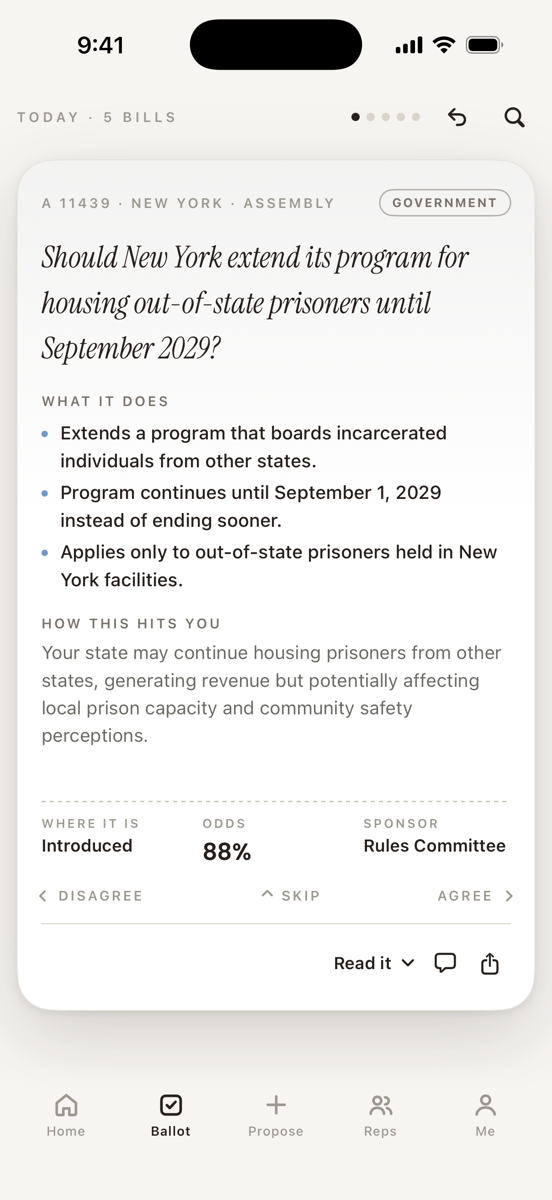
Every day, residents open the free PollSee app and take a side on the real bills moving where they live, in plain English, and propose laws of their own. Each one verified their ID. Nobody is paid to answer. They show up because they want something changed, which is why what they tell us holds up.
PollSee adds those positions together by zip code, strips out anything that points to a person, and never reports a group smaller than five. We work with teams deciding where to site a project, how to shape a bill, and whether a plan will hold once the neighbors hear about it.
Read how a zip code will react to a project before you file for it, and what would change the answer.
Will this zip fight a data center, and what would make them support it?
Put the options in front of the people who live with the result, and see which one they get behind.
Which of our candidate sites meets the least resistance from the people next to it?
The odds a bill survives each gate, the one member whose position moves it, and the date the window closes.
Does this bill clear committee this session, and which member decides it?
Who lives in a zip code now, what they are asking for, and where they are moving.
Who actually lives in this district now, and what are they asking for?
A probability for each procedural gate, not one number. Most bills die at a gate, not a vote, so you see where the risk actually is.
The member whose position is most movable and most load-bearing. Spend usually gets wasted on the wrong person, not the wrong argument.
The date the odds change and what they change to, so timing is a decision instead of a guess.
Share of the zip's blocs with positions on related bills
Share of the committee whose voting record is modeled
Illustrative output. Every simulation also states the population and confidence behind it.
[TODO: the decision they faced and what was riding on it.]
[TODO: how the zip code was expected to react, and why.]
[TODO: what they did differently because of it.]
[TODO: the result, with figures the customer has approved.]
[TODO: one sentence from a partner on what the simulation showed them.]
[TODO: one sentence from a partner on what they changed because of it.]
Synthetic panels generate personas from surveys and scraped text. Ours are people who live at a real address, proved who they are, and took a side on the bills moving where they live.
Every resident in a simulation proved who they are with a government ID and lives at a real address in the zip code.
No name, contact, or individual position ever leaves. Nothing is reported for a group smaller than five.
A simulation helps you decide whether to do something, and how. It is never for working out how to manipulate the people in it.
People can always see the combined results for their own zip code. If you ask how a neighborhood will react, the neighborhood gets the answer as well.
Forecasts are timestamped before the chamber acts and scored against the record after. The misses count too.
Every result says how many residents it ran on and how confident it is, so a thin zip code never passes for a deep one.
Residents read the same rules: how we use your data.
Set that against what one stalled project costs you.
Coverage runs deepest in New York City. Every simulation states how many verified residents it ran on, and a thin zip code returns a wider range instead of a guess.
Tell us the decision, the zip codes, and what's at stake. We'll show you what a simulation returns before you commit to anything.